Subscribe to recieve notifications of our newsletters and brochures

Google Groups
Subscribe to Veteran Tree Group
Email:
Visit this group

Nominate your special tree

OPEN UP THE SIGNIFICANT TREE REGISTER PAGE TOP RIGHT


Sunday, June 20, 2010

Figs; stand out and be recognised

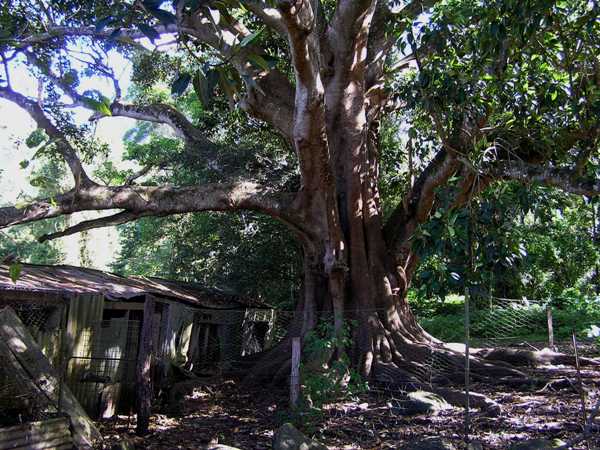
One of the main reasons why figs in Southeast Queensland have such a significant role as historical markers of important phases of white settlement and agricultural development is simply their physical size relative to the vegetation around them.


I have written before how well they stand out on Google Earth pictures and how (relatively) easy it can be to locate significant trees from your desk....in fact it much more the case that we use such aerial photography after we have actually seen a tree 'in the bark'.


Large spreading canopied trees that were both reliable and rapid in their growth have always been desirable on rural properties especially when the vast majority of the vegetation has been removed to permit the particular production process of the farm to progress.

Long after the farm buildings have collapsed into disrepair or been entirely removed, the large dominant figs are often the only remaining reminder of what was once there....and with a little forethought...they can be retained within whatever the current passing phase of landscape use is proposed....(Of course with even less forethought - they are often severely damaged or destroyed)


There can be little doubt that children growing up with such a wonderful natural adventure playground in their midst will develop into adults with different perspectives on the natural world than those who have experienced a far more artificial backdrop to their childhood.


Figs have often been planted onto the stumps of felled Eucalyptus or other previously dominant canopy trees around the farmstead, taking advantage of their epiphytic growth characteristics, their amazing vine like root systems that envelope and swallow anything they encounter.


Of course these remarkable characteristics did not go unnoticed by the early planners and architects of our emerging towns and cities.....but more of that in another post...

Thursday, May 20, 2010

Jacobs Creek.....famous for....Veteran Trees!!!


Here's a name that many overseas readers will know only too well 'Jacobs Creek' is a fairly famous wine producer from the Barossa in South Australia...but how many knew that their real prize is a magnificent collection of absolutely gorgeous Veteran trees.


This area was settle in the 1840's by the Jacob family (amongst others) , William Jacob had been the assistant surveyor to Col. William Light, "Founder of Adelaide", and had surveyed the area around the creek which came to bear his name in the early 1830's.


To be honest I am not all that fussed on the wines and the history of the family is not all that illuminating with respects to the trees....however arguably they were deemed significant enough not to be cleared...whatever the reason we have an incredible group of beautiful veterans to wander around at the Jacobs Creek Visitor Centre.


Defiant Pepper Trees at Greenock SA

On one of the main streets through the small South Australian town of Greenock in the Barossa are two wonderful Veteran Pepper Trees (Schinus molle).

The trees were planted by an early settler Wilhelm Adolph Bachmann in the 1890's, and despite clearly having been heavily lopped and having their roots trashed the trees persist and provide a beautiful street scape that makes this part of Greenock very special indeed.


Greenock is a fascinating and attractive Barossa gem, having numerous cellar doors along its local streets and its own brewery (Barossa Brewing Company) that makes the most fantastic dark porter ale (reminded me of Theakstons Ole Peculiar) and an American style pale ale, the ales are sold on tap at the local pub, you can experience a tasting at the brewery cellar door....but I digress...the trees!


It is worth reminding yourself that the Pepper tree is considered an environmental weed, yet rather like the Camphor Laurel (Cinnamomum camphora) in Queensland, when it reaches this kind of age it has veteran characteristics folds, hollows and scars in its stems and limbs from years gone by that leave you in awe. 

Monday, January 11, 2010

Gundagai veteran

Sean has subtly reminded me that I intended to contribute to this forum, so here I am. I must admit to a degre of nervousness; when I compare myself to the excellent arborists out there I don't feel like I've much to contribute. Perhaps I should be comparing them to some of the awesome veteran trees around the place to get a sense of perspective.

In any case, during my travels I came across a fantastic Eucalyptus camaldulensis, next to Oibell Drive and the historic railway bridge in Gundagai. As seems frequently to be the case, the tree does not look so large and impressive on Google Earth images as some other - evidently younger - trees, but up close it is truly awesome.


As you can see, the canopy of the veteran (indicated by red arrow) is not as broad as some of the other local trees. It does however have significant features of veteranisation, including previous loss of apical stem, canopy senescence, and substantial hollowing.

I couldn't begin to give an accurate assessment of the tree age, and I'd be guessing if I said it was probably at least as old as the nearby railway bridge (also visible in the google shot), which was built in 1902.

I'd be interested if anyone happens to have old photos that might feature this tree - or indeed the location without the tree - in order to provide a more accurate age range. I've contacted to Gundagai library for some more leads. In the mean time, here are some pictures of the tree up close.


Saturday, January 9, 2010

Classic Veteran Tree : Curtain Fig Tree Yungaburra

Another classic Queensland Veteran Tree is the Curtain Fig west of Yungaburra on the Atherton Tablelands.


(Pictures curtesy of Google Earth 2008)

It really is quite incredible to think that until last year 2009 the Curtain Fig Tree was not listed on the Queensland Heritage Register....Whilst there is no doubt that this tree has been afforded protection due to the fact it has been a tourist magnet ever since the first European stumbled across it and raved on about it to their friends (probably over a drink or two!)...and it is inside a gazetted National Park (Curtain Fig NP).

However the slow progress towards officially recording and recognising the significance of many (a great many!) of the natural wonders across our state is frustrating to a great many people.

Each one of us can assist in the task of preserving our own local natural heritage for future generations to enjoy. The Veteran Tree Group is just one of a number of organisations that are working towards similar aims.

Over the years resources have been committed to protecting the forest environment that would otherwise have been overwhelmed by the pressure of the number of visitors walking through this parcel of remnant Mabi Forest.


A very attractive boardwalk talks visitors along a winding path into the amphitheatre that this tree has created through its steady growth


This large strangler fig and its long dead host tree have both fallen into an adjacent tree creating through the growth of aerial roots reaching towards the ground, a complex sheet of fig roots that resemble a frozen waterfall more than a curtain in my opinion.


Whether it looks like a curtain or a frozen waterfall (a curtain of water perhaps is what they meant?) there is no question that of all the many tree species you might encounter in Queensland on your travels veteran fig trees often have th emost mind blowing architecture to both their limbs and roots.

I personally don't really have favourites as such (though I am certain to have made mention of this or that tree as being my favourite!)...it would be hard to try and make comparisons between tree species that can be so very very different in their morphology...however when you look at a veteran tree (really an ancient tree!) like the Curtain Fig it certainly has a strong case for being included in the top ten.